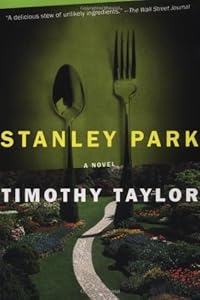
Ù Stanley Park ê PDF Read reviews by ✓ Timothy Taylor eBook or Kindle ePUB free
A love story wrapped in a murder mystery.
Jeremy Papier is a Vancouver chef and restaurateur who owns a bistro called The Monkey's Paw. The novel uses a Bloods vs. Crips metaphor for the philosophical conflict between chefs such as Papier, who favour local ingredients and menus, and those such as his nemesis Dante Beale, who favour a hip, globalized, post-national fusion cuisine.
Papier also endures conflict with his father, an anthropologist studying homelessness in Vancouver's Stanley Park, who draws him into investigating the death of two children in the park. Stanley Park
There were so many things that annoyed me about this book that I am surprised that I finished it, and wondering why I did, though I will admit to a fair amount of skimming. I will not list all of the parts of this book that I found aggravating because I have spent too much time on this book already, and it would likely exceed the GR character limits for reviews. So, here are the bigger points that made me want to throw my poor, innocent e-reader across the room - I did refrain, but reading BLARGH! this book was like rubbing my mind with sandpaper. So, here we go:
>So, Jeremy and his partner in the first restaurant adamantly refuse to have vegetarian options, in Vancouver BC, but then wonder why they are struggling to stay afloat without one vegetarian option ever, in **Vancouver are-you-kidding-me-no-vegetarian-options BC**
-they lose all of those many potential clients, and often their friends but then wonder why they are struggling
-they lose all of those potential, return-business locals because of that ignorant decision
-and seriously, it's VANCOUVER BC AND THEY HAVE NO VEGETARIAN OPTIONS!
-that is just bad business
>Oh, but then they often make off-menu special meals for people involved in the TV-movie industry
-people they know are unlikely to be return customers, and highly unlikely to pass the word on to others, especially others who might be regular clients
>One of the characters actually says something along the lines of 'can't eat tofu because everyone knows it is only f-word for gay people who eat the stuff'
-yes, the author spells out the f-word in the book
-and yes, the author chooses the two syllable version of the word
-yes, it was part of the author's heavy-handed indication that the person saying it was a bad guy but protagonist Jermey laughed along with evil-guy
-and seriously?!? the f-word for gay people?!?!?
-and seriously?!? it's what people are if they eat tofu?!?!?
-and seriously?!?! what about women?!?!?
-and seriously?!?! do people still engage in that level of misogyny and homophobia, and am I supposed to be impressed he crammed so much of each into one short sentence?!?!
-oh, and the book is set in the late 90's so it is not 'just the times'
>and really what about women?
-the men in this book were so shallow but also so overdone that they were almost caricatures rather than characters but they were at least persons.
-the women in this book on the other hand are not really characters at all. Here we have:
--the dead mother, mentioned but not really a character in her own right
--the past love/sex interest about whom Jeremy can wax nostalgic
--the one-who-got-away love/sex interest who ended up with the best friend, and about whom Jermey can wax wistful
--the can't-be-with-you-because-we're-business-partners love/sex interest about whom Jeremey can wax martyrdom
--the add-ahem-'interest'-through-inclusion-of-another-woman love/sex interest about whom Jeremey can wax lust
--a female waitress who make occasional appearances, but whose main scene is to show her man-hating, ranting about males side
--a female culinary school student that Jeremey hires with four young men in the same class
---she is either listed entirely as one of three names along with at least two of the male characters
---while two of the male characters have speaking roles and character - ahem - 'development' this woman remains one of a group
---her only speaking role is to become the butt of an inside joke that the author forces his reader to participate in by having this female character declare that when she opens a restaurant it will serve tofu, having no idea that, apparently in her world, only f-word for gay people people eat it. Blargh seriously?!??
---oh, the news/magazine writer who might have been interesting but only showed up for a couple of pages and ultimately, where she could have had an interesting or important role apparently got scooped by others who were not there (and so how did they get the information?), and ultimately despite her 'bombshell' served the purposes of the evil one who normally would have been harmed by it (so the author was sure to take away any power/standing she had in the book by giving it back to one of the men in it).
-the level of misogyny and sexism in this book was disturbing
>Somewhere around 80% of they way in the first and only decisively non-white character makes an appearance
-not much more than an appearance
-this is a man from Latin America, who is (as the author carefully points out) is very grateful that Jeremey gave him a minimum-wage job as a dishwasher at the new restaurant, because hey, why not also play that are-you-kidding-me stereotype card?
>that's not how homeless people do
>I hated Jeremy
-he is just so completely and utterly annoying, but also just completely and utterly stupid and dishonest and pretentious
and so on, but I am just so utterly done with this book that I refuse to spend any more time on it. I am glad I can return this one to the library and I will not be looking up anymore work by this author.
Paperback Since I see this book on the to-read list of a few of my friends here, I will recommend skipping it. I found it disappointing and hard to follow the whole second plot line on the babes in the woods and his father in Stanley Park. In reading other reviews, it seems this reaction is common. 1582432902 Love food? Love Vancouver? Love gentle-to-moderate satire? Read this book. The main character's split of the food world into Crips (fusion-fancy-tower of exotic ingredients) vs. Bloods (local-rustic) is alone worth it. 1582432902 A fun book but one that you need a computer & wifi near so you can look up words English Rewinding the clock a little, I dove into Timothy Taylor’s Stanley Park after having read his brilliant and compelling (and later) Blue Light Project. Written in 2001, but set a few years earlier, Stanley Park is much more grounded in reality â€" until it isn’t.
Set in post-Expo, pre-Olympics Vancouver â€" a time when I also lived in the city and was deeply involved in civic history projects â€" the novel circles around notions of rootedness. Following the string of connectedness back to whatever it’s tied to is financially-challenged Jeremy Papier, a red-hot up and coming chef with a string of maxed out credit cards and an unacknowledged crush on his culinary partner. Also following what turns out to be a not-so-different string is Jeremy’s grieving and estranged father, The Professor, a self-declared immersive-anthropologist ostensibly studying the homeless in Stanley Park, but perhaps closer to both home and homelessness than his son thinks.
For those unfamiliar with Vancouver, Stanley Park is the green heart of the city, less accessible and wilder than NYC’s Central Park, but alike in its stubbornness to be commoditized at the break-neck speed of the rest of one of North America’s most expensive cities. Established in 1888, it’s completely surrounded by water, except for a slender isthmus; it is connected to the city’s north shore by the spectacular (if crumbling) Lion’s Gate Bridge (if you were ever wondering where Lion’s Gate Films got its name from). The park is a piece of land worth a gazillion dollars and it’s actually pretty easy to get lost if you stray from the paths. The park, with its legends and its history, is profoundly “localâ€, a theme that comes up again and again in Tayor’s story of passion, regret, and â€" food.
Oh, yes, there’s food. Fellow foodies, keep in mind that this story is set well before the farm-to-table movement was in full swing. Jeremy’s devotion to what is seasonal and local â€" and not disguising it with painful fusion-for-fusion’s-sake acrobatics â€" was crisp at the time this novel is set, and possibly at the time it was written.
I savoured the ecstatic descriptions of walk-in freezers. Indulgent discussion of knife work, bordering on fetishism? Oh, yes, please. And rather like The Cook, The Thief, His Wife and Her Lover (remember that movie?), the chef ends up with the last laugh, in ways that are better described than imbibed.
The “Babes in the Woods†story of Stanley Park is (mostly) true. What many people don’t know is that the skeletal remains of two children found in the park in the 1950s are only two of the many bodies that turn up in the park every so often. It’s that kind of park, and Taylor deftly weaves their story with the Professor’s deep reconnaissance mission to understand a cast of intriguing (and mostly male) homeless people.
In the end, food and home â€" and the mystery of the murdered children â€" all come together in one unforgettable evening.
Is Taylor’s vision of homelessness and the top chef restaurant world an exercise in gritty realism? Hell, no. But it doesn’t really matter. Although this is definitely a page-turner, some of Taylor’s phrases stopped me in their tracks with their beauty and their sharp observation. Jeremy’s emotional state as he fast forwards into ruinous debt is described as a “chain of open links, waiting for some critical slackening of tension to disassociate themselves one from another…†With writing like this, the occasional lapses are more noticeable, perhaps. Dante Beale, the grain-fed epitome of corporate greed, is too on-the-nose. He owns a coffee chain called Inferno. He plays chess. And he’s called Dante, for pete’s sake. Likewise, some lesser characters veer into caricature, but Taylor’s right on the money for the important bits.
It’s not really a ‘slice of life in Vancouver circa 1996’; it’s a fabulist’s tale of youthful folly, understanding fathers and father figures, and what back to the land really means.
Stanley Park
So Timothy Taylor’s *Stanley Park* was on the list of books recommended to me when I moved to Vancouver. Not surprising, perhaps, as the book spends a lot of time describing the city: the disparity between rich and poor, the exceptional natural beauty, the pretension of the foodie-hipsters who live here and then, in great detail, the landscape of the largest park (and biggest tourist attraction), Stanley Park.
The protagonist, Jeremy, is an idealistic young chef who owns a hip restaurant and cooks (magnificent) locally sourced meals. The plot thickens as his restaurant struggles to maintain financial solvency, and thickens further as the plot detours to follow Jeremy’s father, “The Professor†who lives IN Stanley Park as part of an ethnographic study of homeless folks who live in the park AND investigating a cold case murder of two children.
I suppose there are some ways in which these two plot lines intersect: Jeremy visits his father in the woods, thematic parallels around local food and local/post-national belonging. But for this reader it felt very much like two plot lines jammed together without the necessary exposition making it clear why a murder mystery and foodie romance belong together. Indeed, even with careful reading I’m still unsure about who/how the murder was committed, why it was significant for Jeremy and what implications it had for The Professor.
So here’s how I take it:
The restaurant plot and Jeremy is great. The writing is decent, the descriptions of food and cooking are great and the questions around independent/small business v conglomerate are interesting and worth exploring.
The Stanley Park plot is terrible. The descriptions try so hard to be literary and poetic that it’s entirely unclear to this reader what is happening, to whom and why. More importantly, I still don’t know why I should care about this plot line. What does it have to do with the local food? with food security?
Hmm. I’ve been telling folks this is a great read (and it did help me past my “Let The Great World Spin†hangover) but in writing this I’m not sure its great so much as the one strand of the novel is great. Can part of a novel be great and the other part terrible and the sum be something like average? I don’t think so. I think it’s still worth reading for the gorgeous food bits, just don’t be surprised if you’re reading and wondering what the hell this Czech guy is doing living on Lion’s Gate Bridge. And maybe also don’t be surprised if you’re a little annoyed with the editor of this book who failed Taylor in not telling him that you can’t just jam two plot flavours together and hope for a satisfying read. Paperback I basically hated this book by the end of it. There's a lot of potentially interesting thematic stuff in it (homelessness in public parks, foodiness, groundedness/sense of place, Vancouver itself), but the whole thing is a hot mess that had me skimming just to get to the goddamn end by final quarter.
Jeremy Papier is a young and talented chef trying to make a farm-to-table restaurant float in crosstown in the late 90s when this was still a new thing. His father is an eccentric anthropologist living in Stanley Park with homeless people. As Jeremy struggles financially, he gets sucked into his father's life in the park at nighttime.
There are so many pointless side/back/off-stories that add nothing. Example: the main character's mother's history, the detailed backstory of homeless people in the park, an unsolved murder, a uncanny god-child, something about first nations people recolonizing the park? None of these things matter in the least. The dialogue is terrible. The late-nineties setting feels dated, and the stuff that should be cool just isn't anymore: the Monkey's Paw Bistro? ugh eew. Even the central love interest is romantic-comedy shallow: attraction, obstacle, resolution. The pacing of the book is horrible - you just want it to be over by the first main plot turn. The final denouement is the longest most drawn out piece of sappy pointlessness I've read in a while.
The most annoying thing about it stylistically is the faux-mysterious faux-cryptic poetic tone adopted at various passages, mostly as Jeremy is wandering around Stanley Park. Maybe the author thinks he's being edgy and cool by having bizarre non sequiturs or leaving simple chronological events mysteriously unfinished, but it is merely ridiculous and artificial. No, you cannot convince me that there is something 'deep' to be gleaned from all this - except maybe that this author tries very, very, hard.
The most successful parts of the book are around food, and take place in and around Jeremy's restaurant kitchen. Jeremy himself isn't a wholly uninteresting character (though pretty much everyone else is). A simpler story about a new restaurant in financial trouble and a complicated relationship with a father would have been so, so much better. This is a book where the flaws of form and content are deeply connected, and there's no easy fix - even an editor taking a hack at it wouldn't work because almost the whole thing is devoted to tangents with no beauty, no emotion, and no real stakes. Maybe very loosely-based movie could work. Literature Fiction I'm not going to finish this. I don't care about the protagonist, the oh-so-passionate chef who wants to serve high end rubber-boot food. (Seems like that describes about about half the chef population, but this is painted as some sort of laudable, novel goal.) I don't care about the secondary characters, especially his father, who lives in a public park as part of an anthropology project on the homeless and is enigmatically remote and weird. Pages and pages of description about how the author used to be in a band has so far not inspired me to care that the author used to be in a band. And I definitely, definitely do not care about the protagonist's devotion to local food. OH MY GOD shut up already. This was written in 2001, when the local food thing was perhaps not as thoroughly over-hyped as it is now. But it's 2009, and WE GET IT already. The book is taking itself very seriously. And the whole thing feels like a pre-write. It needs thinning.
Would I be more invested if this story about local food were more local to me? If the main character's father were living in San Francisco's Golden Gate Park instead of Vancouver's Stanley Park? If the protagonist's precious Monkey's Paw Bistro (hello, annoying name) were located in SOMA? Maybe, but doubt it. Sorry to be so cranky. And in a way I'm sorry that I can't seem to drag myself through to the part where everything goes awry, and he gets bought out by Starbucks, and then solves a really old murder mystery. But life is short. Maybe I'll flip to the end. 436 Couldn't care less about any of the characters. They were all boring and flat. None of them had any depth or likeability to them. The stories all felt thrown together, none of them really took off or held my interest and yet I could see how there was a lot of potential it just never got there. Every story just kind of fizzled out.
And Jeremy hires a bunch of new kids to work the kitchen, tells them, at some point, that they are going to feed everyone at the restaurant opening poached animals from Stanley park including squirrels, raccoons, starlings and pond fish and yet the author doesn't include this conversation in the book?? Come on, that probably would have been the most interesting conversation to take place in the entire book and he just didn't even mention it.
I gave it two stars because I think all the subplots could actually be interesting if any of them were actually developed. Or any of the characters were enjoyable. Stanley Park On the surface, Stanley Park is a simple, albeit fiendishly entertaining, story. Chef Jeremy Papier runs an up-and-coming restaurant in Vancouver -- a restaurant that's devoted to local food, and local atmosphere. The 100 Mile Diet shoved into a little place in Crosstown. He's head chef, and his good friend (and potential romantic interest) Jules Capelli is his sous chef, pastry chef, and restaurant partner in crime. Life is hectic (what life isn't, when restaurants are involved), and there's a niggling disquiet introduced in the first interactions that Jeremy has with his father -- an anthropologist in the midst of a submersive study on the homeless in Vancouver's Stanley Park -- but when the reader is first introduced to all involved, life seems on the whole to be good.
Naturally, of course, things are not so. Jeremy has money issues. His restaurant, though popular and decidedly hip, is losing money. Jeremy is, in fact, in deep shit -- shit that becomes all the more apparent when his scrambling debt finally comes to the attention of his original restaurant investor, Dante Beale.
Dante is a business man and neighbour of Jeremy's father, and he runs a hugely successful chain of coffee houses in Vancouver called Inferno. (Some articles on the novel have highlighted the obviousness of these monikers, but as a gal who has done some obvious character naming in her time, I found them hilariously fun.) Dante has also been wanting to get his hands on Jeremy's restaurant for some time, much to the chagrin of the lovely sous-chef, and this all comes to a head about halfway through the book, when Jeremy must finally go to Dante and admit his money failures.
Running parallel to the restaurant woe is another storyline involving Jeremy and his father, the Professor. As mentioned, the Professor is doing a study on the homeless people who live in Stanley Park. While initially somewhat estranged, Jeremy's own fascination with local food and what it means inevitably draws him closer to his father's world. The closeness that develops between the two men over the course of the novel was, I felt, a beautiful thing to watch. Guarded at first, but unfolding slowly, like the trees themselves ...
Anyway. Big Bad Dante steps in, finally, and takes the restaurant over. Guts the place. Hires Jeremy's new paramour (a beguiling -- and yet oddly repulsive, in a you're-too-charming-to-be-true kind of way -- girl named Benny) as the new decorator, and proceeds to turn the restaurant into precisely the kind of uber-hip, urban fusion cuisine juggernaut that Jeremy's spent his whole career fighting quietly against.
What a bastard! (Can you say bastard in a book review? Oh well.) Oooh, the transformation of the restaurant got me so mad. But the descriptions of the food were delicious, and my faith in Jeremy Papier strong, and so I continued ...
I don't think I can say much more without giving away the plot, but the resolution of this novel basically staggered me with its brilliant execution. Reading the latter half of this novel was like watching one continuous panned shot of a sophisticated, culinary art film. (I doubt that culinary art is a film genre, but it should be. Fact.) Bright flashing colours and subterfuge and good-looking people all over the place. Again -- fiendishly entertaining. So, so good.
But what lifted this book above mere entertainment for me, and put it into that realm of the Seleckys and the Atwoods, was how Taylor managed to combine his restaurant narrative and his anthropological narrative in such a fantastic conclusion at the end. So good. This is a novel of ideas that somehow also manages to be a novel of concrete textures and people and colours. It's fun, but also hugely important, and while this might sound simple, too often these are hard things to achieve all at the same time. (This is where my you'll never be this good ever ever voice kicks in.)
Somehow, though, Taylor does it. And he does it all in such a fun, funny, entertaining way, with language that's straight and clean while still managing to be breathtaking and innovative all at the same time.
So this is a book that's floored me, basically. This is the kind of novel -- not least of all because it's about food -- that makes me want to be a writer, to be a person who can use her words well, and build a world that makes the reader see their own world differently, even after the book's conclusion. Of course it's not perfect (though I'm pretty darn close to thinking of it so) -- the build up to Jeremy's financial meltdown lasts maybe a little longer than it should, and Benny shifts out of Jeremy's life rather quickly in the last third of the book -- but overall these are tiny, tiny niggles. I loved every inch of this novel. I wish there was a sequel. I'm going to read and re-read this and savour the language every time. English


Komentar
Posting Komentar