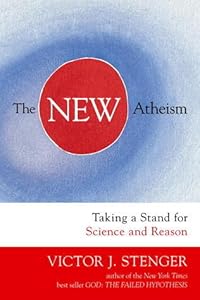
Browse your favorite ☆ The New Atheism: Taking a Stand for Science and Reason PDF by ☆ Victor J. Stenger eBook or Kindle ePUB free
An excellent review and summary of the latest thoughts in modern atheism. 9781591027515 Very good read 9781591027515 Mostly a rehash of his other books but still a good read. Great overview of all his Atheist ideas. Paperback The New Atheism has some wonderful chapters, but ultimately I was left with more interest in the other works Stenger routinely cites than this book itself. I'm not sure how much new content it brings forward, but it's a nice overview. Victor J. Stenger Victor Stenger reviews the efforts of the New Atheists.
There is nothing more to say. Read it!! 1591027519
In recent years a number of bestselling books have forcefully argued that belief in God can no longer be defended on rational or empirical grounds, and that the scientific worldview has rendered obsolete the traditional beliefs held by Christianity, Judaism, and Islam. The authors of these booksâ€"Richard Dawkins, Daniel Dennett, Sam Harris, Christopher Hitchens, and Victor J. Stengerâ€"have come to be known as the New Atheists. Predictably, their works have been controversial and attracted a good deal of critical reaction.
In this new book, Victor J. Stenger, whose God: The Failed Hypothesis was on the New York Times bestseller list in 2007, reviews and expands upon the principles of New Atheism and answers many of its critics. He demonstrates in detail that naturalismâ€"the view that all of reality is reducible to matter and nothing elseâ€"is sufficient to explain everything we observe in the universe, from the most distant galaxies to the inner workings of the brain that result in the phenomenon of mind.
Stenger disputes the claim of many critics that the question of whether God exists is beyond the ken of science. On the contrary, he argues that absence of evidence for God is, indeed, evidence of absence when the evidence should be there and is not.
Turning from scientific to historical evidence, Stenger then points out the many examples of evil perpetrated in the name of religion. He also notes that the Bible, which is still taken to be divine revelation by millions, fails as a basis for morality and is unable to account for the problem of unnecessary suffering throughout the world.
Finally, he discusses the teachings of ancient nontheist sages such as Buddha, Lao Tzu, and Confucius, whose guidelines for coping with the problems of life and death did not depend upon a supernatural metaphysics. Stenger argues that this way of nature is far superior to the traditional supernatural monotheisms, which history shows can lead to a host of evils.
The New Atheism is a well-argued defense of the atheist position and a strong rebuttal of its critics. The New Atheism: Taking a Stand for Science and Reason
I read this book twice. The first time was back in the summer and I skimmed through it pretty fast. This time, I read it much slower and made notations throughout. I think it is sad that the new atheists are not taken seriously, especially by themselves! It sort of reminds me of how wimpy the Democratic Party was during (and after) the 2010 elections, but that's another matter.
I totally agree with Stenger that atheists are not about eradicating religion, we just want to co-exist without being preached to. Stenger says, Faith is belief in the absence of evidence. Science is belief in the presence of evidence. When the evidence disagrees with a scientific proposition, the proposition is discarded. When the evidence disagrees with a religious proposition, the evidence is discarded. . . . It is not the universe that is unreasonable or not. It is people that are unreasonable or not. (p. 239) I have made it my goal to not be preachy about my new-found unbelief but, alas, the believers tend to put me on the defensive stance. It should not be that way.
Stenger says, We are not trying to shut down religious institutions, but we have a right as citizens to object to the illegal and unconstitutional distribution of taxpayer money to these institutions and other special privileges they are awarded by cowardly politicians. And, we feel it is our duty to protest when government officials rely on superstition instead of science to make decisions that affect the lives of everyone on the planet. (pp. 239-240)
One more statement that is important to the thrust of this book: We see nothing wrong with asking the faithful to provide evidence and rational arguments for their faith, rather than us keeping quiet as do so many of our atheist and agnostic friends for fear of offending deeply held beliefs. (p. 239)
I am inspired by Stenger, as well as Dawkins, Harris, Dennett, and Hitchens, to take a stand for science and reason. It seems like a reasonable and upstanding thing to do!
-----
Second reading started: December 1, 2010; finished December 6, 2010.
Third reading started: May 6, 2013; finished May 12, 2013. 282 Read the whole thing while sitting in Borders. Very well done. Amply sums up the last five or so years of a type of cultural criticism that I'm in strong support of. English While the book provides a survey of the ideas comprising the new atheism and the relevant publications which gave rise to the movement (if one could call it that), it is poorly written and is not in the same class with the books by Harris, Dawkins, Dennett, and Hitchens. Stenger comes across as a shameless self promoter and drops the names of other books he has written at every opportunity. His unique contribution to the new atheism (according to Stenger) is his assertion that the absence of evidence is evidence of absence if one would expect the evidence to be there. While this is a good rule of commonsense, it seems an odd assertion for a scientist to make while advocating the scientific study of the existence or nonexistence of gods. The book is useful for its review of the literature but offers no truely original contributions to the subject. And then there are the egregious errors! On p. 58, he denies the historicity of Jesus on the basis of lack of external evidence but does not address the verisimilitude of the nonmythological materials about the ministry of Jesus in the New Testament, nor does he give a reason for the invention of the historical Jesus. On pp. 110-11, he quotes from the archaic, misleading, and at times deficient Authorized Version (KJV) in order to make a point about Mark 14: 3-9, which he lacks the scholarly background to understand in context. On p. 127, he expresses doubt in the historicity of Muhammad with the same lack of evidence or argument that he uses to deny the historicity of Jesus. For information on the history of religions, he relies on Karen Armstrong, a popular writer rather than a scholar, and summarizes her writings at length (a case of the blind leading the blind). On page 205 (during his summary of Armstrong), he gets confused with BCE dating and declares that Thales of Miletus predicted an eclipse of the sun in 585 BCE a year before the destruction of Jerusalem (an event he has already dated as 586 BCE). On p. 243, he gets the dates reversed for the two events, putting the destruction of Jerusalem in 585 BCE and the eclipse in 586. On p. 207, he does not question the existence of the historical Buddha (Gotama), although even some Buddhist scholars deny his historicity, but he does (following Armstrong?) get the traditional dates wrong, placing him toward the end of the fifth century BCE. The traditional date for the Buddha's birth is circa 560 BC with his death occuring in the early fifth century BC. My advice is to read the real new atheists (Harris, Hitchens, Dawkins, and Dennett) and use Stenger as a reference for the literature on the movement(including opposing viewpoints). There is a need for a comprehensive overview of the new atheism for use in college courses, but Stenger is not qualified to write it. 9781591027515 This is an awesome book provided you already have a coherent knowledge of metaphysics, religion, and history. He wrote this book as a response to criticisms of the New Atheism movement and without a sound base, much of what he discusses would go over the casual readers head. This is not the first book to read if you're curious what New Atheism is about. But, if you are already well versed in the literature; this is a MUST read. I loved this book and devoured it. The New Atheism: Taking a Stand for Science and Reason I think this book was an excellent summary of the arguments against a personal God in the universe. The author uses science and philosophy to argue against the presence of God. He also discusses some of the atrocities committed by religions, and explains why the new atheists oppose religion so strenuously. Also interesting was his analysis of how less religious societies have fewer social problems and religious societies, fewer murders, less poverty, less violence and crime, etc. This neatly debunks the belief of so many theists that religion is necessary for morality. Some of the stuff I already knew, but I found some valuable information about science that successfully debunks many of the Christian apologists who claim that the universe is fine-tuned for life or that there are so many gaps in scientific knowledge that God is the inevitable cause of life. An excellent book. English


Komentar
Posting Komentar